Tata Harrier EV vs. Mahindra XEV 9e:
A Matter of Maturity.
We sit down to analyze the two finest electric SUVs India has ever produced. A detailed look at the drivetrain capabilities, the rear-seat realities, and the long-term ownership proposition.
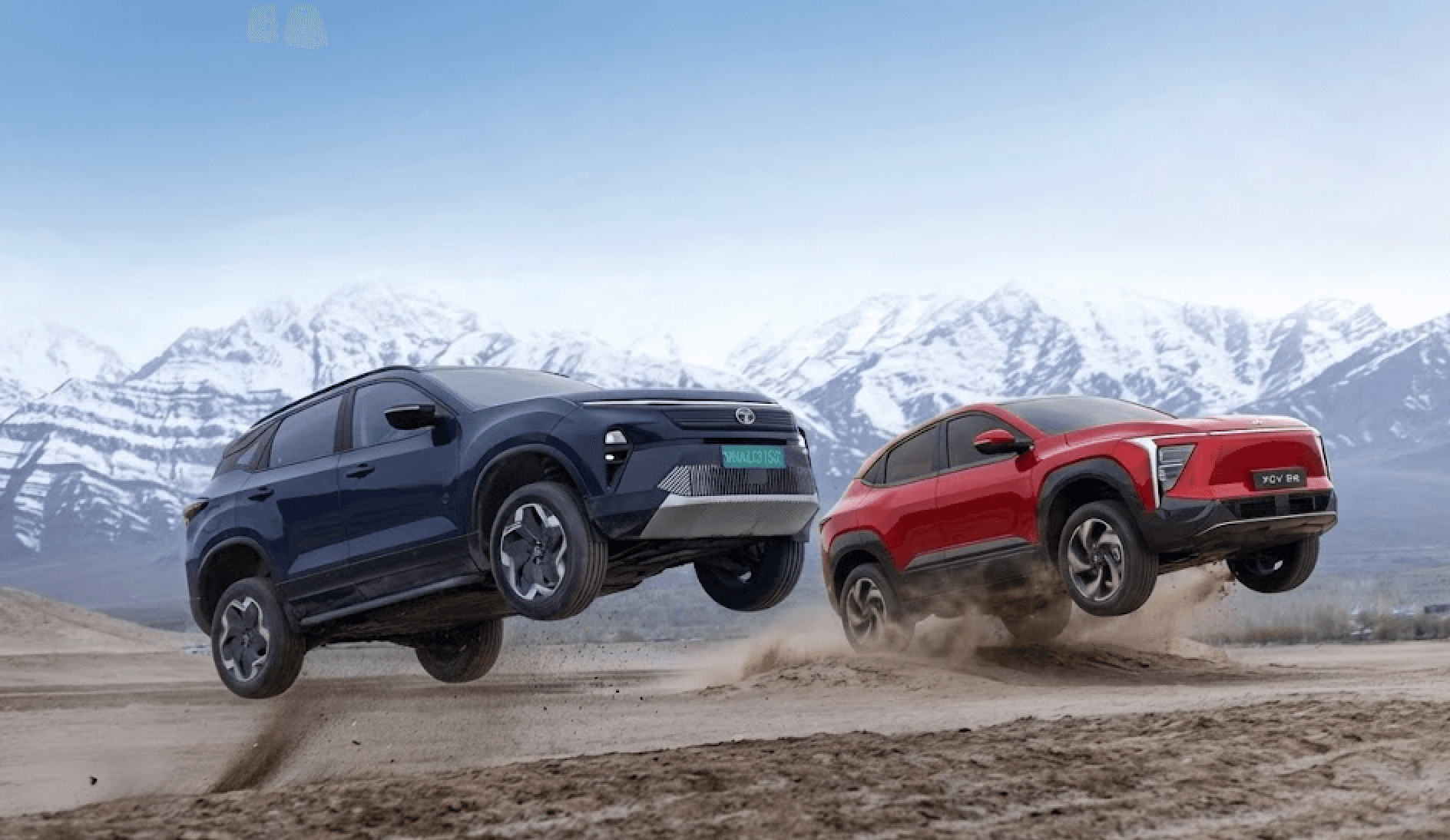
Design & Cabin Space
Tata Harrier EV: The Traditionalist
The Harrier remains the handsome, conventional choice. It carries that "Solid Build" reputation with strong road presence. The biggest advantage of this traditional shape is the roofline. Because it doesn't slope aggressively like a coupe, the rear headroom is excellent. You don't feel hemmed in, and the cabin feels airy. However, the boot space is surprisingly average—actually less than the diesel Harrier due to the electric components—and competition offers more luggage room.
Ergonomically, there are compromises. The floor-mounted battery raises the cabin floor, resulting in a knees-up seating position at the rear which hampers under-thigh support. Furthermore, the driver's seat fore-and-aft movement range is slightly restricted compared to the ICE version, which might be an issue for very tall drivers trying to find the perfect driving position.
Safety Note: The Harrier still lacks a center rear headrest. In a flagship car costing ₹30 Lakh, this omission puts the middle passenger at risk during whiplash incidents.
Mahindra XEV 9e: The Radical
The XEV 9e is bold and futuristic, with a styling that has divided opinions. Physically, it is the bigger car with spacious interiors. Mahindra has utilized that extra length well: the 663-litre boot is massive, and it features a usable 150-litre Frunk (front trunk) supported by hydraulic struts.
However, the coupe styling comes at a cost: the high window line and sloping roof eat into the sense of space inside the cabin, making it feel slightly more enclosed than the airy Harrier. But make no mistake—the actual space inside is slightly better, and the reclining rear seats significantly boost comfort on long journeys.
Safety Win: The XEV 9e includes a proper three-point seatbelt and headrest for the middle rear passenger, plus 7 airbags and Level 2+ ADAS.
The Tech Experience: A Deep Dive
Mahindra XEV 9e: The "Triple Screen" Setup
Mahindra has thrown the kitchen sink at this cabin. It runs on the Qualcomm Snapdragon 8295 chipset, ensuring zero lag. The feature list is endless: UV filtration glass, selfie cameras, and an Infinity roof with interactive lights.
- •Triple-Screen Layout: You get three 12.3-inch screens. The passenger screen is independent—kids or co-passengers can stream content via built-in apps without distracting the driver.
- •Augmented Reality (AR) HUD: A segment-first feature. It projects navigation arrows virtually onto the road ahead, reducing the need to look down.
- •16-Speaker Harman/Kardon: Features Dolby Atmos and Logic 7 surround sound. It is incredibly immersive.
Tata Harrier EV: Functional Simplicity
The Harrier takes a more traditional approach. It lacks the third screen and HUD but compensates with a massive 14.5-inch Neo QLED central display that is sharp and responsive.
- •540-Degree View: Tata's camera system is excellent, offering a transparent chassis view that helps significantly in tight parking spots or off-road trails.
- •Digital IRVM: A camera feed replaces the standard rear-view mirror. This is a huge practical win over the Mahindra, especially when the boot is fully loaded.
- •JBL Audio System: 10 Speakers with a Subwoofer. It includes Dolby Atmos and while it has fewer speakers than the Mahindra, the bass response is deep and punchy.
Critical Feature Differences
Dashcam / DVR
The Harrier has a proper dual dashcam setup that records continuously. The XEV 9e relies on G-sensors to save footage only during incidents, which might miss context.
Daily Usability
The XEV 9e lacks physical controls for HVAC or volume, burying them in screens. The Harrier retains some tactility, making it easier to use while driving.
Insulation: The Silence Test
Mahindra markets their "acoustic glass" heavily, and it works—the cabin is library quiet. But do not underestimate the Tata. The Harrier EV's sound insulation is surprisingly on par. Tata has done a fantastic job sealing the cabin against wind and road noise. Unless you drive them back-to-back, you likely won't notice a significant deficit in either car.
Powertrain & Ride Quality
This is where the personalities diverge completely. The XEV 9e is the driver's choice. It sits on a sophisticated skateboard platform with semi-active dampers that make it corner flat and handle with European sharpness. Its single motor sends 282 BHP to the rear wheels, launching it from 0-100 km/h in 6.8 seconds. It features One-Pedal Driving that is beautifully tuned for city traffic—you rarely need to touch the brake.
In terms of pure response, the XEV 9e feels peppier; it reacts instantly to throttle inputs. However, the Harrier EV (QWD) fights back with sheer grunt. With a dual-motor setup delivering 235 BHP (Rear) + 156 BHP (Front)—combined to roughly 304 BHP—it hits 0-100 km/h in just 6.3 seconds. While it delivers performance in a calm manner in standard modes, engaging Boost Mode unleashes a beast that feels significantly more exciting than the Mahindra, aided by the massive traction advantage of All-Wheel Drive.
The Ride Quality pulls a surprise card. Despite having a simpler suspension setup on paper, the Harrier EV rides better on Indian roads. It has a "velvety" quality to the way it absorbs potholes, lacking the springy, busy feel the Mahindra sometimes exhibits over broken patches. However, when you start pushing hard, the XEV 9e claws back points with agile steering and sharp, confidence-inspiring brakes (all-wheel discs on both). The Harrier's brakes, while effective, suffer from a spongy pedal feel that saps confidence during spirited driving.
The AWD Factor
The Harrier is the only one offering an All-Wheel Drive (AWD) variant. If you live in areas with slush, steep inclines, or frequent monsoons, this mechanical grip is a USP that no amount of software or RWD dynamics in the Mahindra can replicate.
Service Reality
Mahindra, while also having its share of issues, generally has fewer niggles than Tata, and their service centers are significantly better managed. Tata's service experience remains a gamble depending on your local dealer, and the 6-month service interval is annoying compared to the annual norm.
The Value Equation
Battery Warranty: A Tie
It is worth noting that both Tata and Mahindra now offer a Lifetime Warranty on the battery pack for the first owner. This levels the playing field significantly—peace of mind regarding the most expensive component is guaranteed with either choice.
The ₹3 Lakh Gap
The real differentiator is the price. If we compare the Rear-Wheel Drive variants, the Harrier EV is approximately ₹3 Lakhs cheaper than the XEV 9e.
That is a significant saving. For ₹3 Lakhs less, you get a car that rides softer, offers similar sound insulation, and has a more practical rear seat for elders. The XEV 9e is arguably the "better" car technically with better dynamics, futuristic cabin and bigger storage but is it ₹3 Lakhs better?
The AWD Harrier is a proper sophisticated machine that excites while driving beautifully on and off the road. If you need AWD, the choice is clear.
If you are worried about Tata niggles and service center visits (Mahindra generally has fewer electronic bugs and better service management), don't care about AWD, and want the absolute best quality for your money, get the XEV 9e. However, for the vast majority of buyers, the Harrier EV offers 90% of the experience for significantly less money.
Scorecard
- Ride ComfortHarrier EV
- Tech & FeaturesXEV 9e
- PracticalityXEV 9e
- Battery WarrantyTie (Lifetime)
- PowertrainTie
- Value for MoneyHarrier RWD
If you want the absolute cutting edge of technology, European driving dynamics and a futuristic cabin that wows passengers, pay the premium for the Mahindra XEV 9e. But if you want a handsome, robust, velvet-riding family SUV that keeps ₹3 Lakhs in your pocket, the RWD Tata Harrier EV is the sensible, mature choice that will likely satisfy most Indian families. Of course, the Harrier is a no brainer if you want AWD.
Connecting the dots
A flagship purchase isn't just about the showroom price:
- •Running cost calculator – see if the efficiency difference matters at this price point.
- •Battery life & warranty – compare the degradation curves of these large packs.
- •Safety Data – review the crash safety protocols for these flagship EVs.
Idea is to see the full picture: what you pay upfront, what you save to run it, how long the battery lasts, and what you can sell it for at the end.