Battery life · India
EV batteries: what's realand what's just noise.
Battery life is the biggest fear people have about EVs in India. But most of this fear comes from older chemistries and outdated examples. Modern LFP and NMC batteries behave very differently — and we now have real-world long-term data to prove it.
1. How long modern EV batteries actually last
Almost every EV in India today ships with an 8-year warranty guaranteeing around 70% battery health — and Tata/Mahindra now offer extended “lifetime” warranties going up to around 15 years for LFP packs.
To a lot of people this feels like marketing. It's not just vibes, it's backed by global fleet data:
- • Geotab analysis (10,000+ EVs): average degradation ~1.8% per year (mixed chemistries).
- • VW ID.3 tested 160,000 km by ADAC: still around 91% battery health.
- • Tesla Model 3/Y fleet: roughly 12–15% loss after about 322,000 km.
Modern EVs generally lose 1–3% of battery capacity per year. Most people will sell the car before the battery becomes the limiting factor.
2. LFP batteries degrade even slower
The numbers above mix all chemistries. But Indian EVs like Mahindra EVs, MG EVs, Tata EVs use LFP chemistry in many of their models, which is even more stable:
- • LFP shows some of the lowest calendar aging among lithium-ion chemistries.
- • Lab studies: often <1% per year aging at moderate temperatures/SoC.
- • Real-world: Tesla LFP packs retain about 95% capacity after ~177,000 km (≈110,000 miles).
For a typical Indian use case (around 12,000 km/year), a conservative LFP estimate is roughly 1.2% capacity loss per year. Real cars can and do perform better than that in many cases.
3. 10-year projection for a typical Indian LFP EV
Below is a conservative model: linear 1.2% loss per year at 12,000 km/year driving. Real-world LFP results are often better, but this is a safe, easy-to-understand baseline.
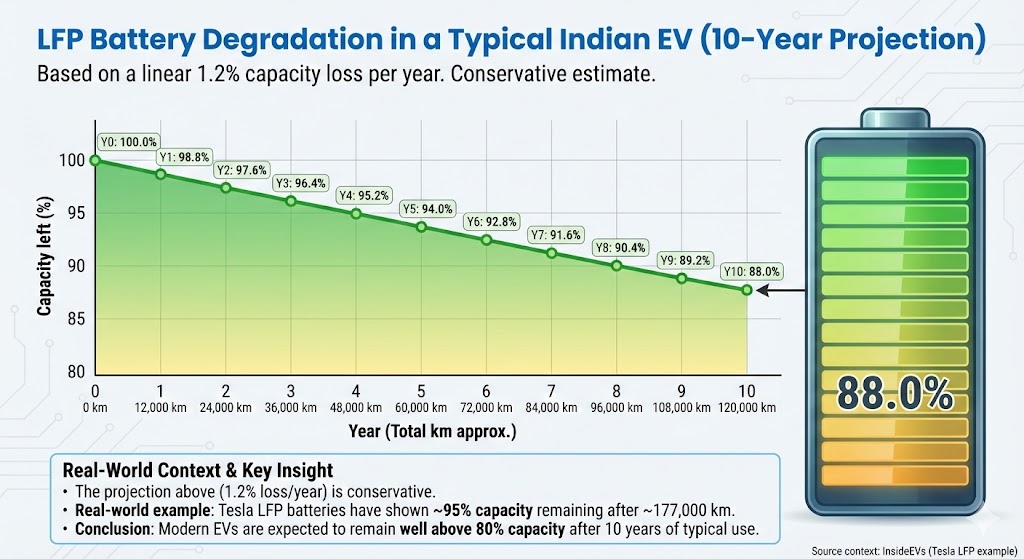
Infographic based on LFP degradation research + Tesla LFP long-term data.
| Year | Total km | Capacity left |
|---|---|---|
| 0 | 0 km | 100% |
| 1 | 12,000 km | 98.8% |
| 2 | 24,000 km | 97.6% |
| 3 | 36,000 km | 96.4% |
| 4 | 48,000 km | 95.2% |
| 5 | 60,000 km | 94.0% |
| 6 | 72,000 km | 92.8% |
| 7 | 84,000 km | 91.6% |
| 8 | 96,000 km | 90.4% |
| 9 | 108,000 km | 89.2% |
| 10 | 120,000 km | 88.0% |
4. Larger batteries degrade slower
Bigger batteries age better because they require fewer full charge cycles for the same distance driven.
- • A small 24–30 kWh pack might cycle 300–350 times/year for a high-mileage user.
- • A large 60–80 kWh pack might be closer to ~140–180 cycles/year for the same km.
- • Fewer cycles = slower cycle-related degradation.
This is why long-range EVs (Tata Harrier.ev, Mahindra XEV9e, MG ZS EV LR, BYD Atto 3 and similar) often retain their battery health remarkably well over time when used normally.
5. Older EV batteries really did degrade faster
The "EV batteries die in 5 years" line mostly comes from older EVs like the first-gen Nissan Leaf, which had:
- • No liquid cooling at all.
- • Early NMC chemistry not optimised for hot climates.
- • High heat exposure in markets like Arizona, California, etc.
- • Less advanced BMS software and pack design.
Modern Indian EVs (Tata, Mahindra, MG, BYD, Hyundai and others) use:
- • Stable LFP or newer NMC cell chemistries.
- • Liquid thermal management systems in most mainstream models.
- • Smart charging algorithms and SoC buffers to avoid stress zones.
- • Better pack architecture to prevent hotspots and cell imbalances.
So mixing first-gen Leaf stories with current LFP or modern NMC packs is like judging today's phones based on a 2008 Nokia battery.